Step out of Sinchon Station and you will find a university whichever way you turn. Yonsei, Ewha Womans University, and Sogang sit around the neighborhood like a broad enclosure. Inside it are restaurants, bars, cafés, and shops. The streets are still busy. But to those who have known Sinchon for a long time, the neighborhood has a history that the streets alone cannot explain.
Some neighborhoods have music that only the people who spent time there can hear. Sinchon has many such songs. Some music was born here; other songs sound like the hearts of people on their way to meet someone in Sinchon. Much later, a song appeared about being unable to return at all.
Let’s listen as we walk through Sinchon. It is one way to move between the neighborhood we see today and the one we remember.
Sinchon Blues “Regret”
I was still in high school when I first heard “Regret.” Despite its title, I found nothing wanting in the song. I loved the rhythm, the words, even the instrumental break that came in off the beat. To me, it was perfect blues.
The band, and the album, happened to be called Sinchon Blues. I immediately imagined that if I went to Sinchon, I would hear music this good all the time. The fantasy did not come from knowing the neighborhood. It was the other way around: the music made a Sinchon I had never visited.
Sinchon Blues formed in 1986 at Red Zeppelin, a live club in Sinchon, where Eom In-ho, Lee Jung-sun, Kim Hyun-sik, Han Young-ae, and others gathered. Red Zeppelin is gone. The venues of that time have disappeared, but if you want to feel a trace of that era in Sinchon today, I suggest a visit to Woodstock.
The moment you step inside, you can feel time layered through the room, from the years when Sinchon was a living center of music to the present. Order a beer you like. Request a song you want to hear; Woodstock still takes requests. Wait for it to come on. Listen. Then you can leave.
That is a good way to begin a musical walk through Sinchon.
Bicycle Riding Landscape “To You, Me; To Me, You”
Yonsei University’s Sinchon campus is known for its beauty. Many Korean films and dramas have been shot there. If I had to choose one, it would be the 2003 film The Classic.
The film has become, true to its name, a classic of Korean romance cinema.
I did not see it in a theater. I watched it long after its release. I am not usually drawn to lavish tearjerkers, but I watched it that day. Perhaps I needed a reason to cry.
There is a famous scene. Rain pours down. Two young people, just beginning to acknowledge their feelings for each other, run across the campus, soaked through. Bicycle Riding Landscape’s “To You, Me; To Me, You” plays.
Put on your earphones when you enter Yonsei and play “To You, Me; To Me, You.” Like Son Ye-jin and Jo In-sung, start at Yeonhui Hall, leave your footprints on the little paths around Underwood Hall, and come back out onto Baekyang-ro.
Exhibition “An Essay on Memory”
Minerva opened in 1975. It is Sinchon’s oldest café, having stayed in the same place for half a century. I spent a great deal of time there as a university student. I would climb the creaking wooden stairs to the second floor and sit at the counter running along the windows, usually alone. I always ordered hazelnut coffee. It may sound funny now, but around the year 2000 in Korea, hazelnut was a rather sophisticated coffee order.
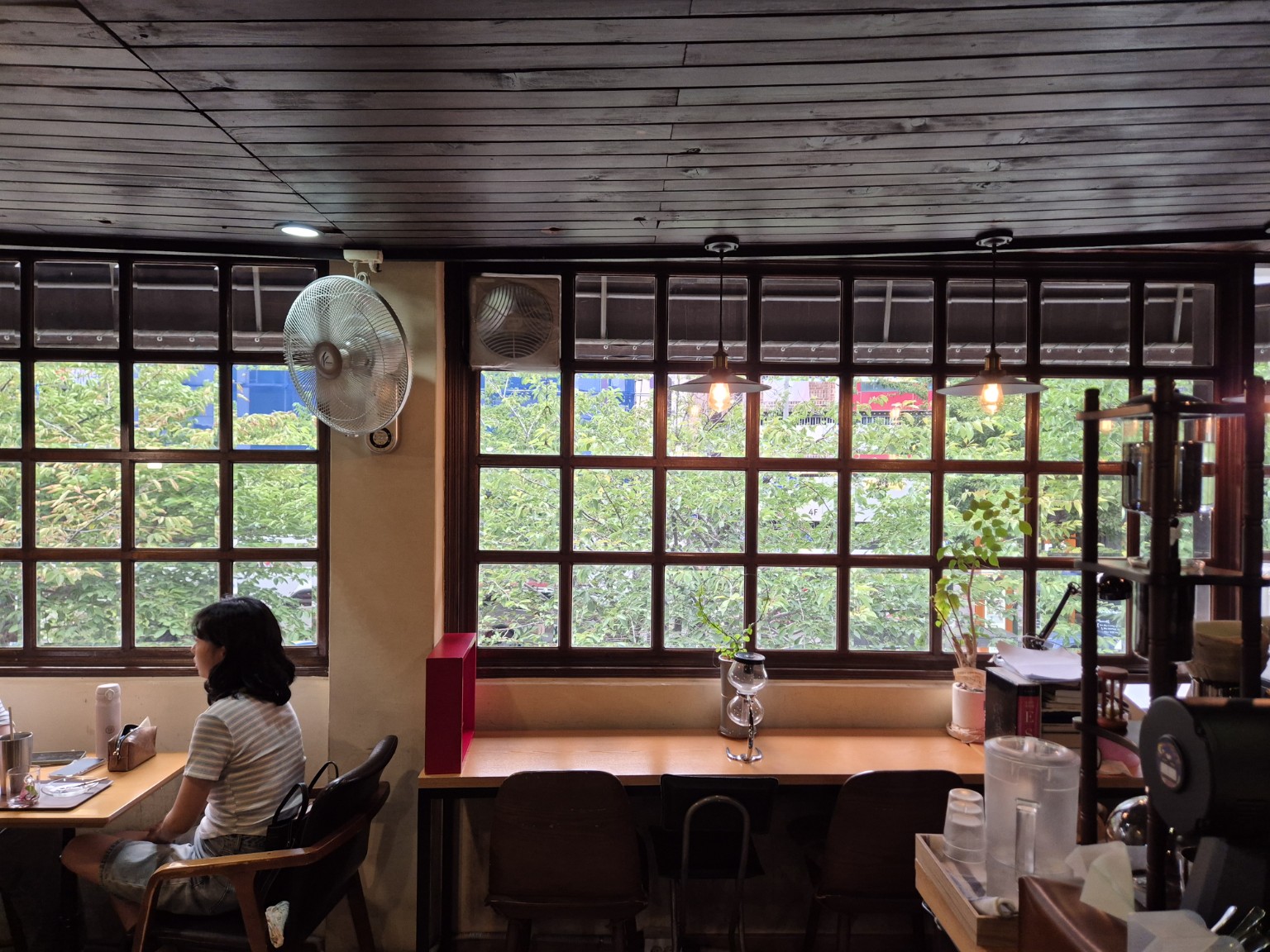
I do not quite know why I went to Minerva so often. The heart is strange around the age of twenty. I would feel happy, then suddenly unsettled for no obvious reason. I cannot tell whether I went there to calm that feeling or to make it stronger. If youth has its brilliance, it also has its wavering.
Many young people in those unsteady years listened to Exhibition. The duo was made up of Kim Dong-ryul and Seo Dong-wook, both Yonsei alumni. Their song “An Essay on Memory” later called up another generation’s youth through the film Architecture 101: two students meet, then look back on that time years later. It is a story rather like Sinchon, and the Yonsei campus appears in the film too. Exhibition has many ties to the university.
I recommend listening to “An Essay on Memory” by a second-floor window at Minerva, with a cup of coffee. It does not have to be hazelnut.
If youth has its brilliance, it also has its wavering.
Weather Forecast “I Like You, I Like You”
When making plans with someone, we often used to say, “Let’s meet in Sinchon.” That was usually enough. We might meet at Exit 3 of Sinchon Station or in front of Doksuri Dabang. In those days, young men often walked the streets carrying roses, a single flower or a whole bunch. Their steps were light; perhaps they were on their way to see a girlfriend. When I picture that scene, Weather Forecast’s “I Like You, I Like You” starts playing in my head as its soundtrack.
As Korea developed its economy and democracy at remarkable speed, before it became the affluent country it is today, there was a great deal of romance and optimism in the air. Of course, that does not mean everyone was happy. Still, many people believed tomorrow would be better than today. For a long time, university students did not have to worry much about finding work. Perhaps those who enjoyed that optimism most fully were the people in their twenties.
Sinchon was one of the Seoul neighborhoods where they gathered. Like a young man walking to meet someone with roses in his hand, it felt light. People went to Sinchon to meet people.
Postmen “I Can’t Go to Sinchon”
Let us stand in the same place again, this time after some years have passed. I stopped going to Sinchon in the mid-2000s. You might say that was only natural after graduation. But if Sinchon had remained the center of youth culture, I would still have gone there to meet friends. At some point, I was not the only one who had left. Other people were leaving too.
Places where young culture and music thrived moved toward Hongdae to escape rising rents. The neighborhood where we met friends changed; so did the one where we went to listen to music alone. Sinchon drifted away from our everyday lives.
Yet even after people stopped going there, Sinchon did not disappear from music. It returned as a place of memory. In 2013, Postmen sang “I Can’t Go to Sinchon.”
The title itself is strange. We once went to Sinchon to meet someone we loved. Now we cannot go there because of someone we used to love.
A long time lies between Weather Forecast’s “I Like You, I Like You” and Postmen’s “I Can’t Go to Sinchon.” But listen to the songs back to back at Sinchon Station, and the years seem to pass in an instant.
Still in Sinchon
Sinchon is not what it used to be. But young people are still here. Like me at twenty, they waver from time to time, and still they are impossibly bright, full of the blue of youth.
As a little bonus, I have added a video of Suzy, formerly of miss A and the star of Architecture 101, singing the Yonsei cheer song “Yonsei, I Love You” at the university’s Akaraka festival.
To youth, to Sinchon: I love you!